Transcript
[Handwritten text]
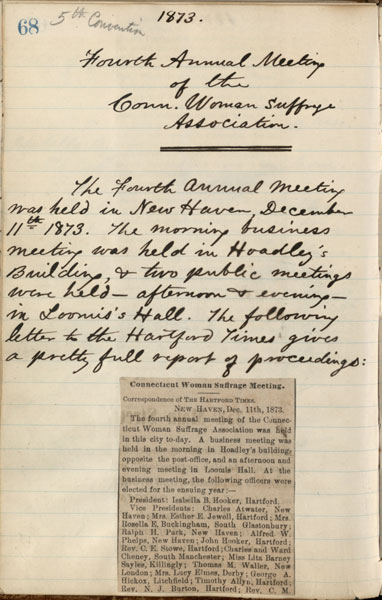
Fourth Annual Meeting of the Conn[ecticut] Woman Suffrage Association
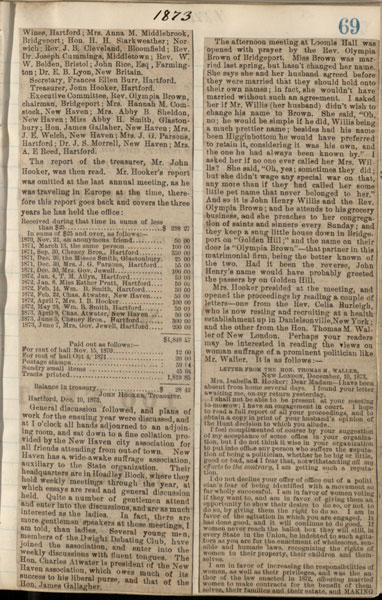
The Fourth Annual Meeting was held in New Haven, December 11th, 1873. The morning business meeting was held in Hoadley's1 Building, & two public meetings were held--afternoon & evening--in Loomis's Hall. The following letter to the Hartford Times gives a pretty full report of the proceedings:
[Newspaper clipping inserted into the minute book] Connecticut Woman Suffrage Meeting
Correspondence of The Hartford Times New Haven, Dec. 11th, 1873
The fourth annual meeting of the Connecticut Woman Suffrage Association was held in this city to-day. A business meeting was held in the morning at Hoadley's building, opposite the post-office, and an afternoon and evening meeting in Loomis Hall. At the business meeting, the following officers were elected for the ensuing year:--
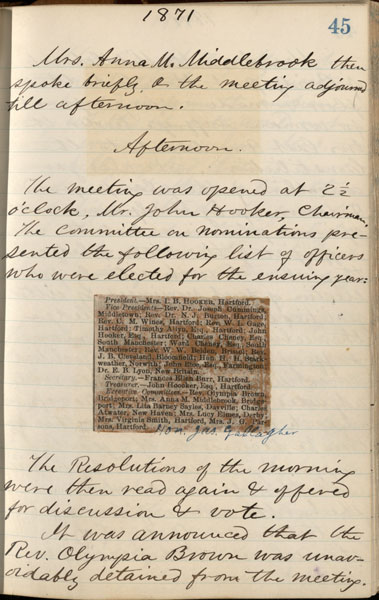
President: Isabella B. Hooker, Hartford
Vice Presidents: Charles Atwater, New Haven; Mrs. Esther E. Jewell, Hartford; Mrs.
Rosella E. Buckingham, South Glastonbury; Ralph H. Park, New Haven; Alfred W. Phelps, New Haven; John Hooker, Hartford; Rev[erend]. C.E. Stowe, Hartford; Charles and Ward Cheney2, South Manchester; Mrs. Lita Barney Sayles, Killingly; Thomas M. Waller, New London; Mrs. Lucy Elmes, Derby; George A. Hickox, Litchfield; Timothy Allyn, Hartford; Rev. N.J. Burton, Hartford; Rev. C.M. Wines, Hartford; Mrs. Anna M. Middlebrook, Bridgeport; Hon[orable]. H.H. Starkweather, Norwich; Rev. J.B. Cleveland, Bloomfield; Rev. Dr. Joseph Cummings, Middletown; Rev. W.W. Belden, Bristol; John Rice, Esq[uire]., Farmington; Dr. E.B. Lyon, New Britain.
Secretary: Frances Ellen Burr, Hartford.
1 Pronounced: HODE - lee
2 Pronounced: CHAY - nee
Treasurer: John H. Hooker, Hartford.
Executive Committee, Rev. Olympia Brown, chairman, Bridgeport; Mrs. Hannah M. Comstock, New Haven; Miss Abby H. Smith, Glastonbury; Hon. James Galla[g]her, New Haven; Mrs. J.E. Welch, New Haven; Mrs. J.G. Parsons, Hartford; Dr. J.S. Morrell, New Haven; Mrs. A.E. Reed, Hartford.
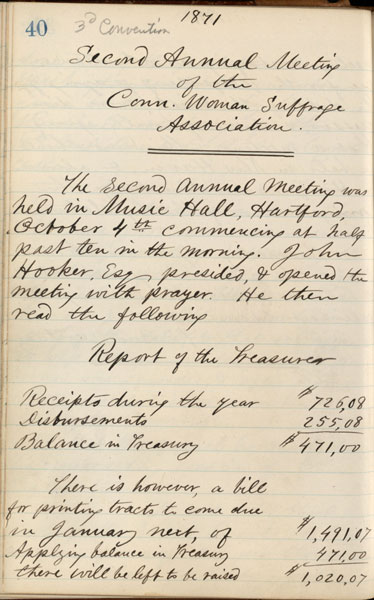
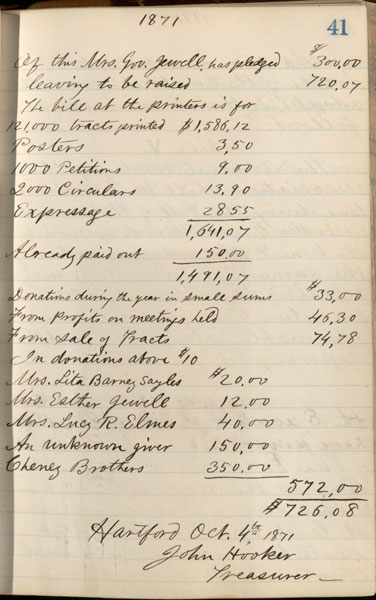
The report of the treasurer, Mr. John Hooker, was then read. Mr. Hooker's report was omitted at the last annual meeting, as he was traveling in Europe at the time, therefore this report goes back and covers the three years he has held the office:
Received during that time in sums of less than $25.00. $ 298.27
In sums of $25 and over, as follows:
1870, Nov. 21, an anonymous friend..................................................................... 50.00
1871, March 31, the same person ......................................................................... 100.00
1871, Sept. 30, Cheney Bro[ther]s., Hartford........................................................ 350.00
1871, Dec. 26, the Misses Smith, Glastonbury...................................................... 25.00
1871, Dec. 30, Mrs. J.G. Parsons, Hartford............................................................ 55.00
1871, Dec. 30, Mrs. Gov[overnor]. Jewell............................................................. 100.00
1872, Jan. 4, T.M. Allyn, Hartford......................................................................... 50.00
1872, Jan. 8, Miss Esther Pratt, Hartford................................................................ 50.00
1872, Feb. 14, W[illia]m. B. Smith, Hartford......................................................... 50.00
1872, Feb. 22, Cha[rle]s. Atwater, New Haven...................................................... 50.00
1872, April 7, Mrs. I.B. Hooker.............................................................................. 100.00
1872, May 23, Wm. B. Smith, Hartford…............................................................. 50.00
1873, April 9, Chas. Atwater, New Haven............................................................. 50.00
1873, June 5, Cheney Bros., Hartford........... ........................................................ 300.00
1873, June 7, Mrs. Gov. Jewell, Hartford.............................................................. 200.00
$1,848.27
Paid out as follows:
For rent of hall Nov. 15, 1870.............................................................................. 12.00
For rent of hall Oct. 4, 1871............................................................................ 20.00
Postage stamps................................................................................................. 59.04
Sundry small items........................................................................................... 45.04
Tracts printed. $1,848.27
Balance in treasury........................................................................................... $ 28.42
JOHN HOOKER, Treasurer
Hartford, Dec. 10, 1873.
General discussion followed, and plans of work for the ensuing year were discussed, and at 1 o'clock all hands adjourned to an adjoining room and sat down to a fine collation provided by the New Haven city association for all friends attending from out of town.
New Haven has a wide-awake suffrage association, auxiliary to the State organization. Their headquarters are in Hoadley Block, where they hold weekly meetings through the year, at which essays are read and general discussion held. Quite a number of gentlemen attend and enter into the discussion, and are as much interested as the ladies. In fact, there are more gentleman speakers at these meetings, I am told, than ladies. Several young men, members of the Dwight Debating Club, have joined the association, and enter into the weekly discussions with fluent tongues. The Hon. Charles Atwater is president of the New Haven association, which owes much of its success to his liberal purse, and that of the Hon. James Gallagher.
The afternoon meeting at Loomis Hall was opened with prayer by the Rev. Olympia Brown of Bridgeport. Miss Brown was married last spring, but hasn't changed her name. She says she and her husband agreed before they were married that they should hold onto their own names; in fact, she wouldn't have married without such an agreement. I asked her if Mr. Willis (her husband) didn't wish to change his name to Brown. She said, "Oh, no; he would be simple if he did, Willis being a much prettier name; besides had his name been Higginbottom he would have preferred to retain it, considering it was his own, and the one he had always been known by."I asked her if no one ever called her Mrs.
Willis?" She said, "Oh, yes; sometimes they did; but she didn't wage any special war on that, any more than if they had called her some little pet name that never belonged to her." And so it is, John Henry Willis and the Rev. Olympia Brown; and he attends to his grocery business, and she preaches to her congregation of saints and sinners every Sunday; and they keep a snug little house down in Bridgeport on "Golden Hill"; and the name on their door is "Olympia Brown"--that partner in this matrimonial firm, being the
better know of the two. Had it been the reverse, John Henry's name would have probably greeted the passersby on Golden Hill.
Mrs. Hooker presided at the meeting, and opened the proceedings by reading a couple of letters--one from the Rev. Celia Burleigh3, who is now resting and recruiting at a health establishment up in Danielsonville, New York; and the other from the Hon.
Thomas M. Waller of New London. Perhaps your readers may be interested in reading the views on woman suffrage of a prominent politician like Mr. Waller. It is as follows:--
LETTER FROM THE HON. THOMAS M. WALLER.
New London, December 10, 1873.
Mrs. Isabella B. Hooker: Dear Madam--I have been absent from home several days. I found your letter awaiting me on my return yesterday.
I shall not be able to be present at your meeting to-morrow; I have an engagement in court. I hope to read a full report of all your proceedings, and to obtain a copy in print of your husband's opinion of the Hunt decision to which you allude.
I feel complimented of course by your suggestion of my acceptance of some office in your organization, but I do not think it wise in your organization to put into office any person who suffers the reputation of being a politician, whether he be big or little, good or bad, and I fear that, notwithstanding all my efforts to the contrary, I am getting such a reputation.
I do not decline your offer of office out of a politician's fear of being identified with a movement so far wholly successful. I am in favor of women voting if they want to, and in favor of giving them an opportunity to show their desire to do so, or not to do so, by giving them the right to do so. I am in favor of the agitation in which you are engaged. It has done good, and it will continue to do good. If women never reach the ballot box they will still, in every State in the Union, be indebted to such agitators as you are for the enactment of wholesome, sensible and humane laws, recognizing the rights of women to their property, their children and themselves.
I am in favor of increasing the responsibilities of women, as well as their privileges, and was the author of the law enacted in 1872, allowing married women to make
3 Pronounced: BURR-LEE
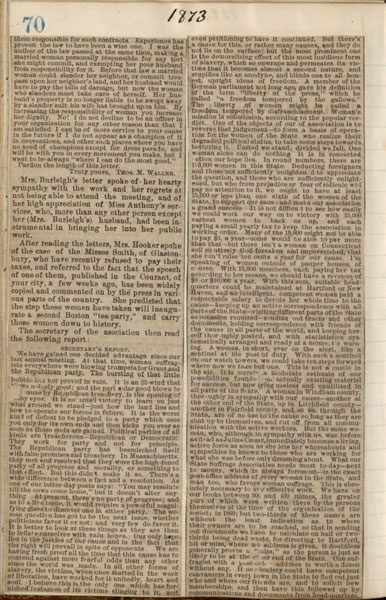
contracts for the benefit of themselves, their families and their estate, and MAKING them responsible for such contracts. Experience has proven the law to have been a wise one. I was the author of the law passed at the same time, making a married woman personally responsible for any tort she might commit, and exempting her poor husband from responsibility for it. Before that law a married women could slander her neighbor, or commit trespass upon her neighbor's land, and her husband would have to pay the bills of damage, but now the woman who slanders must take care of herself. Her husband's property is no longer liable to be swept away by a slander suit his wife has brought upon him. By increasing the responsibility of woman you increase her dignity. No! I do not decline to be an officer in your organization for any other reason than that I am satisfied I can be of more service to your cause in the future if I do not appear as a champion of in conventions, and other such places where you have no need of champions except the for dress parade, and will be with you in every movement you make, but I want to be always, "where I can do the most good."
Truly yours, Tho[ma]s. M. Waller
Mrs. Burleigh's letter spoke of her hearty sympathy with the work and her regrets at not being able to attend the meeting, and of her high appreciation of Miss Anthony's services, who, more than any other person except her (Mrs. Burleigh's) husband, had been instrumental in bringing her into her public work.
After reading the letters, Mrs. Hooker spoke of the case of the Misses Smith, of Glastonbury, who have recently refused to pay their taxes, and referred to the fact that the speech of one of them, published in the Courant, of your city, a few ago, has been widely copied and commented on by the press in various parts of the country. She predicted that the step these women have taken will inaugurate a second Boston "tea-party," and carry these women down to history.
The secretary of the association then read the following report: SECRETARY'S REPORT.
We have gained one decided advantage since our last annual meeting. At that time, woman suffragists everywhere were blowing trumpets for Grant and the Republican party. The bursting of that little bubble has not proved in vain. It is an ill-wind that blows
nobody good; and the particular good blown to [illegible] cause of Republican treachery, is the opening of many eyes. It is no small victory to learn on just what ground we stand-- just how the land lies and how to operate our forces in future. It is the worst kind of defeat to be pledged to a party which uses you only for its own ends and then kicks you over as soon as those ends are gained. Political parties of all kinds are treacherous-- Republican or Democratic. They work for party and not for principle. The Republican party has besmirched itself with false promises and treachery. In Massachusetts, they met and resolved that they were the high-toned party of all progress and morality, or something to that effect. But this didn't make it so. There's a wide difference between a fact and a resolution. As one of our latter-day poets says: "You may resolute till the cows come home," but it doesn't alter anything. At present, there's no party of progress; and as to a live issue, it would require a powerful magnifying-glass to discover one in either party. The woman question has got to be the next issue, whether politicians favor it or not; and very few do favor it. It is better to look at these things as they are than to inflate ourselves with vain hopes. Our only hope lies in the justice of our cause and in the fact that the right will prevail in spite of opponents. We are having fresh proof all the time that this cause has to contend against more fearful odds than any other since the world was made. In all other forms of slavery, the victims, when once started in the work of liberation, have worked for it unitedly, heart and soul. I believe this is the only one which has furnished instances of its victims clinging to it, and event petitioning to have it continued. But there's a cause for this, or rather many causes, and they do not lie on the surface; but the most prominent one is the demoralizing effect of this most insidious form of slavery, which so enwraps and permeates its victims that it becomes almost a second nature, and stupefies like an anodyne, and blinds one to all honest, upright ideas of freedom. A member of the German parliament not long ago, gave his definition of the term "liberty of the press," which he called "a freedom tempered by the gallows." The liberty of women might be called a freedom tempered by disfranchisement. Woman's mission is submission, according to the popular verdict. One of the objects of our association is to reverse that judgement [sic]--to form a basis of operation for the women of the State who realize their degraded political status, to take some steps towards bettering it. United we stand; divided we fall. One woman alone can do nothing. It is in
concerted action our hope lies. In round numbers, there are 100,000 women in this State. Deducting foreigners and those not sufficiently enlightened to appreciate the question, and those who are sufficiently enlightened, but who from prejudice or fear of ridicule will pay no attention to it, we ought to have at least 15,000 or less than one sixth of the women of the State, to support our cause and make our association a grand success. It is not difficult to see how easily we could work our way on to victory with 15,000 earnest women to back us up, and each paying a small yearly tax to keep the association in working order. Many of the 15,000 might not be able to pay $1 a year--some would be able to pay more than that--but here isn't a woman on Connecticut soil so utterly God- forsaken and impoverished, that she can't raise ten cents a year for our cause. I'm speaking of women outside of pauper house, of course. With 15,000 members, each paying her tax according to her means, we should have a revenue of $8 or $10,000 a year. With this sum, Suitable headquarters could be maintained at Hartford on New Haven, and an intelligent, competent woman paid a respectable salary to devote her whole time to the cause--keeping up an active correspondence with all parts of the State--visiting different parts of the State as occasion required--sending out tracts and other documents, holding correspondence with friends of the cause in all parts of the world, and keeping herself thoroughly posted, and with statistics systematically arranged and ready at a moment's warning. A woman, in short, ever on the alert, like a sentinel at his post of duty. With such a sentinel on our watch towers, we could take ten steps forward where now we take but one. This is not a castle in the air. It is merely a moderate estimate of our possibilities founded on actually existing material for success, but now lying useless and unutilized in all parts of the State. A woman in Windham county, thoroughly in sympathy with our cause--another at the other end of the State in Fairfield county, and so on through the State, are of no use to the cause so long as they are shut up to themselves, and cut off from all communication with active workers. But the same woman, who, although in sympathy with us, was before as dead as Julius Caesar, immediately becomes a living, active force as soon as she lets her whereabouts and sympathies be known to those who are working for what she was before only dreaming about. What our State Suffrage Association needs most to-day --next to money, which is always foremost--is the exact post-office address of every woman in the State, and man too, who favors woman
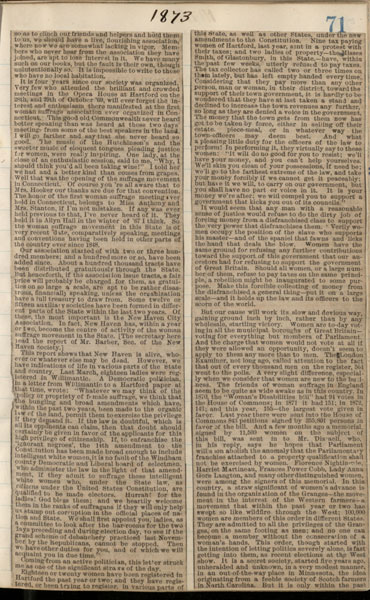
suffrage. This is absolutely necessary to any effective work. We have on our books between 300 and 400 names, the greater part of which were written there by the persons themselves at the time of the organization of the society in 1869; but two-thirds of these names are without the least indication as to where their owners are to be reached, so that in sending out documents we have to calculate on half or two-thirds being dead waste, for directing to Hartford, hit or miss, where no address is given, it doubtless generally proves a "miss," as the person is just as likely to be at the other end of the State. One suffragist with a post-office address is worth a dozen without any. If one Society could have competent canvassers in every town in the State to find out just who and where our friends are, and to solicit new memberships, and then have this followed up by communications and documents from head-quarters, so as to clinch our friends and helpers and hold them to us, we should have a live, flourishing association, where now we are somewhat lacking in vigor. Members who never hear from the association they have joined, are apt to lose interest in it. We have many such on our books, but the fault is their own, though unintentionally so. It is impossible to write to those who have no local habitation.
It is four years since our society was organized. Very few who attended the brilliant and crowded meetings in the Opera House at Hartford on the 28th and 29th of October '69, will ever forget the interest and enthusiasm there manifested at the first woman suffrage association ever organized in Connecticut. This good old Commonwealth never heard better speaking than was heard at those two days' meetings, from some of the best speakers in the land. I will go farther and say that she never heard so good. The music of the Hutchinson's and the sweeter music of eloquent tongues pleading justice for women, were really inspiring. One lady, at the close of an enthusiastic session, said to me, "Why, I should think you'd all been taking wine!" I told her we had and a better kind than comes from grapes. Well that was the opening of the suffrage movement in Connecticut. Of course you're all aware that to Mrs. Hooker our thanks is due for that convention. The honor of the first woman suffrage meeting ever held in Connecticut, belongs to Miss Anthony and Mrs. Stanton, if I'm not mistaken. If any was ever held previous to that, I've never heard of it. They held it in Allyn Hall in the winter of '67 I think. So the woman
suffrage movement in this State is of very recent date, comparatively speaking, meetings and conventions having been held in other parts of the country ever since 1848.
Our association started of [sic] with two or three hundred members; and a hundred more or so, have been added since. About a hundred thousand tracts have been distributed gratuitously through the State. But henceforth, if the association issue tracts, a fair price will probably be charged for them, as gratuities on so large a scale are apt to be rather disastrous, financially speaking, unless the organization have a full treasury to draw from. Some twelve or fifteen auxiliary societies have been formed in different parts of the State within the last two years. Of these, the most important is the New Haven City Association. In fact, New Haven has, within a year or two, become the centre of activity of the woman suffrage movement in the State. [The secretary here read the report of Mr. Barber, Sec. of the New Haven Society.]
This report shows that New Haven in alive, whoever or whatever else may be dead. However, we indications of life in various parts of the State and country. Last March, eighteen ladies were registered in Willimantic. A Democratic politician, in a letter from Willimantic to a Hartford paper at that time, wrote: "Whatever we may think of the policy or propriety of female suffrage, we think that the bungling and broad amendments which have, within the past two years, been made to the organic law of the land, permit them to exercise the privilege if they demand it. If the law is doubtful, which is all its opponents can claim, then that doubt should certainly be given in favor of the applicants for this high privilege of citizenship. If, to enfranchise the "ignorant negroes", the 14th amendment to the Constitution has been made broad enough to include intelligent white women, it is no fault of the Windham county Democratic and Liberal board of selectmen, who administer the law in the light of that amendment, if they admit to suffrage those intelligent white women who, under the State law, as citizens under the United States Constitution, are qualified to be made electors. Hurrah! for the ladies! God bless them; we heartily welcome them in the ranks of suffragans if they will only help us stamp out corruption in the official places of nation and state. We shall first appoint you, ladies, as a committee to look after the bar-rooms for the two days preceding and during election day, to see if the grand scheme of debauchery practiced last November by the
Republicans, can be stopped. Then we have other duties for you, and of which we will acquaint you in due time."
Coming from an active politician, this letter struck me as one of significant straws of the day.
Eighteen or twenty women have been registered in Hartford the past year or two; and they have registered, or been trying to register, in various parts of this State, as well as other States, under the new amendment to the Constitution. Nine tax paying women of Hartford, last year, sent in a protest with their taxes; and two ladies of property--the Misses Smith, of Glastonbury, in this State,--have within the past few weeks, utterly refused to pay taxes. The tax collector has called two or three times on them lately, but has left empty handed every time. Considering that they pay more than any other person, man or woman, in their district, toward the support of their town government, it is hardly to be wondered that they have at last taken a stand and declined to increase the town revenues any further, so long as they are denied a voice in the government. The money that the town gets from them now has got to be taken by force, either in selling off their estate piece-meal or in whatever way the town-officers may deem best. And what a pleasing little duty for the officers of the law to perform! In performing it, they virtually have to say to these women: "It will do no good for you to resist; we'll have your money, and you can't help yourselves. We'll skin you clean of your possession, if need be; we'll go to the farthest extreme of the law, a take our money forcibly if we cannot get it peaceably; but have it we will, to carry on our government, but you shall have no part of voice in it. It your money we're after; we will compel you to support a government that kicks you out of its councils."
It would seem that any man with a reasonable sense of justice would refuse to do the dirty job of forcing money from a disfranchised class to support the very power that disfranchises them. Verily women occupy the position of the slave who supports his master--and of the spaniel that fawns and licks the hand that deals the blow. Women have the same ground for refusing any further contributions toward the support of this government that our ancestors had for refusing to support the government of Great Britain. Should all women, or a large number of them, refuse to pay taxes on the same principle, a rebellion might be inaugurated to some purpose. Make this forcible collecting
of money from the disfranchised a general thing--put it on a large scale--and it holds up the law and its officers to the scorn of the world.
But our cause will work its slow and devious way, gaining ground inch by inch, rather than by any wholesale, startling victory. Women are to-day voting in all the municipal boroughs of Great Britain--voting for everything but members of Parliament. And the charge that women would not vote at all if they were allowed an opportunity, doesn't seem to apply to them any more than to men. The London Examiner, not long ago, called attention to the fact that out of every thousand men on the register, 564 went to the polls. A very slight difference, especially when we consider that women are new to the business. The friends of woman suffrage in England seem to be quite as wide awake as in this country. In 1870, the "Woman's Disabilities bill" had 91 votes in the House of Commons; in 1871, it had 151; in 1872, 143; and this year, 155--the largest vote given in favor. Last year there were sent into the House of Commons 843 petitions signed by 355,801 persons in favor of the bill. And a few months ago a memorial, signed by 11,500 women on the subject of this bill, was sent in to Mr. Disraeli4, who, in his reply, says he hopes that Parliament will soon abolish the anomaly that the Parliamentary franchise attached to a property qualification shall not be exercised by women. Florence Nightingale, Harriet Martineau5, Frances Power Cobb, Lady Anna Gore Langton, and many other distinguished women, were among the signers of this memorial. In this country, a straw significant of women's advance is found in the organization of the Granges--the movement in the interest of the Western farmers--a movement that within the past year or two has swept like wildfire through the West; 100,000 women are members of this order in different States. They are admitted to all the privileges of the Granges, on the same footing as men; and no one can become a member without the consecration of woman's hands. This order, thought started with the intention of letting politics severely alone, is fast getting into them, as recent elections at the West show. It is a secret society, started five years ago, unheralded and unknown, in a very modest manner, in an out-of-the-way place in Minnesota, the idea originating from a feeble society of Scotch farmers in North Carolina. But it is only within the past year or two that
4 Pronounced: Diz - RAIL - ee
5 Pronounced: Mar - TIN - oh
it has taken on such a wonderful growth as to surprise the world. It is making itself feared by all parties, who are trying to court its favor. A hundred thousand women in such an organization as this, ought to wield an influence for the benefit of their own sex. What a power that would be, were they all to unite for one single purpose--the enfranchisement of women. Perhaps events will take a turn that way some day, and the agricultural granges become woman suffrage granges as well. If women are to be members of such great organizations, they will have to secure the ballot to keep pace with their brother members and with the times, and also to maintain a proper self-respect, as well as the respect of others.
We are rapidly approaching our nation's centenary. Shall the joy-bells of '76 peal out with one half the nation still in subjection? This would be firing guns and blowing trumpets for only a partial victory. And those women who are forming a "Woman's Centennial Association" to help on the great celebration do little realize how degrading is the work they are doing--blowing trumpets for the power that keeps them in subjections. They had far better turn about--form an association of women to mourn in sackcloth and ashes and mark in a fitting manner the hundredth of a nation which calls itself a republic and keeps one half its people in subjection. Better muffle the bells and put the flags at half-mast, than fire guns of rejoicing over a half-slave nation.
When Jacob Bright's bill was under discussion in the British Parliament a year or two ago, a member rose and said it was an attempt to alter the laws of creation, and turn the world upside down. If women have such a tremendous reserve force as this, that with the ballott [sic] in their hands they can turn the world upside down, it is time this force were put to some account. Certainly the creator never intended it to lie idle.
In similar vein to this member of Parliament, a gentleman said to me not long ago, that if women were enfranchised, it would let hell loose on earth; and added: "Suppose a woman possesing [sic] the power of the ballot, were to belong to one political party and her husband to another--what would be the result?" This startling conundrum reminded me of the Lord Mayor's to Anne Askew. Come centuries ago, during a fierce conflict between Protestants and Papists, there was a young woman in London by the name of Anne Askew, who was strongly suspected of Protestant leanings, but there couldn't be found the least possible pretext for convicting her. So the Lord Mayor of London had her
summoned before him, and supposed a case, in order to have her commit herself. Said he, "Ann Askew, suppose a mouse were to eat some of the consecrated bread of the communion, what would become of that mouse?" "Nay, my Lord," said she, "but you say what would become of that mouse." "I say that mouse would be eternally damned, " thundered the Lord Mayor of London. "Alack, poor mouse!" was her only reply. To these suppositious cases in regard to women, we can only reply, "Alack, poor woman!"
Frances Ellen Burr, Secretary.
Hartford, Dec. 10, 1873.
Mrs. Hooker then delivered an able address. After congratulating the friends on the progress of the work, she said:
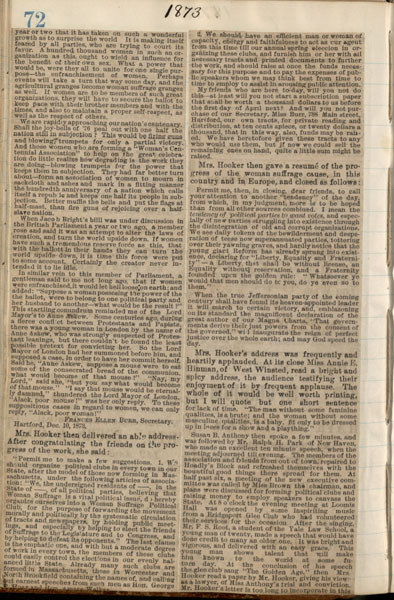
"Permit me to make a few suggestions. 1. We should organize political clubs in every town in our State, after the model of those now forming in Massachusetts, under the following articles of association: "We, the undersigned residents of ---, in the State of ---, of all political parties, believing that Woman Suffrage is a vital political issue, do hereby organize ourselves into a Woman Suffrage Political Club, for the purpose of forwarding the movement morally and politically by helping to elect the friends of Suffrage to the Legislature and to Congress, and by helping to defeat its opponents." The last clause is the emphatic one, and with but a moderate degree of work in every town, the members of these clubs could easily control the elections in our evenly balanced little State. Already many such clubs are formed in Massachusetts, those in Worcester6 and North Brookfield containing the names of, and calling out earnest speeches from such men as Hon. George [Illegible] Hoar and Hon. Amasa7 Walker.
2. We should have an efficient man or woman of capacity, energy and faithfulness to act as our agent from this time till our annual spring eleccion [sic] in organizing these clubs, and furnish him or her with all necessary tracts and printed documents to further the work, and should raise at once the funds necessary for this purpose and to pay the expenses of public speakers whom we may think best from time to time to employ to assist in arousing public attention.
6 Pronounced: WUU - stah
7 Pronounced: AM - ah - see
My friends who are here to-day, will you not do this--at least will you not start a subscription paper that shall be worth a thousand dollars to us before the first day of April next? And will you not purchase of our Secretary, Miss Burr, 788 Main [S]treet, Hartford, our own tracts, for private reading and distribution, at ten cents apiece, or twenty dollars a thousand, that in this way, also, funds may be raised. We have heretofore given these tracts to any who would use them, but if now we could sell the remaining ones on hand, quite a little sum might be raised.
Mrs. Hooker then gave a resume of the progress of the woman suffrage cause, in this country and in Europe, and closed as follows:
Permit me, then, in closing, dear friends, to call your attention to another "tendency" of the day, from which, in my judgment, more is to be hoped than from all other sources combined. I mean the tendency of political parties to want votes, and especially of new parties struggling into existence through the disintegration of old and corrupt organizations. We see daily tokens of the bewilderment and desperation of teese [sic] now superannuated parties, tottering over their yawning graves, and hardly notice that the young giant Reform has already sprung into existence, declaring for "Liberty, Equality and Fraternity"--a Liberty that shall be without license, and Equality without reservation, and a Fraternity founded upon the golden rule: "Whatsoever ye would that men should do to you, do ye even so to them."
When the true Jeffersonian party of the coming century shall have found its heaven- appointed leader it will march to certain victory, and, emblazoning on its standard the magnificent declaration of the great author of our Magna Charta, "That governments derive their just powers from the consent of the governed," will inaugurate the reign of perfect justice over the whole earth; and may God speed the day.["]
Mrs. Hooker's address was frequently and heartily applauded. At its close Miss Annie
E. Hinman, of West Winsted, read a bright and spicy address, the audience testifying their enjoyment of it by frequent applause. The whole of it would be well worth printing, but I will quote but one short sentence for lack of time. "The man without some feminine qualities is a brute; and a woman without some masculine qualities, is a baby, fit only to be dressed up in laces for a show and a plaything."
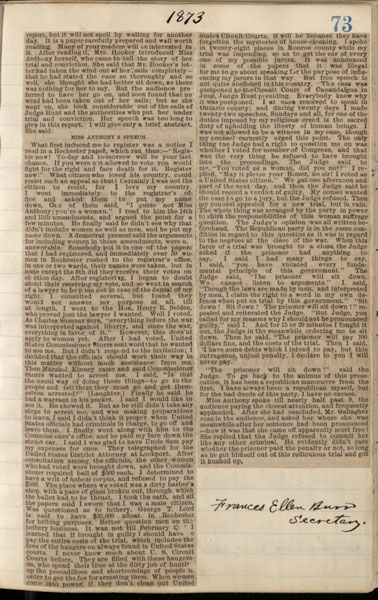
Susan B. Anthony then spoke a few minutes, and was followed by Mr. Ralph H. Park of New Haven, who made an excellent ten minute speech, when the meeting adjourned till evening. The members of the association and friends from out of town, repaired to Hoadly's Block and refreshed themselves with the bountiful good things there spread for them. At half past six, a meeting of the new executive committee was called by Miss Brown the chairman, and plans were discussed for forming political clubs and raising money to employ speakers to canvass the State. At 8 o'clock the evening meeting at Loomis Hall was opened by some inspiriting music from a Bridgeport Glee Club who had volunteered their services for the occasion. After the singing, Mr. F.S. Root, a student at the Yale Law School, a young man of twenty, made a speech that would have done credit to many an older one. It was bright and vigorous and delivered with an easy grace. This young man shows talent that will make him known to the world at some future day. At the conclusion of his speech, the glee club sang "The Golden Age," then Mrs. Hooker read a paper by Mr. Hooker, giving his views as a lawyer, of Miss Anthony's trial and conviction. Mr. Hooker's letter is too long to incorporate in this report, but it will not spoil by waiting for another day. It is a paper carefully prepared and well worth reading. Many of your readers will be interested in it. After reading it, Mrs. Hooker introduced Miss Anthony herself, who came to tell the story of her trial and conviction. She said that Mr. Hooker's letter had taken the wind out of her sails, completely--that he had stated the case so thoroughly and so well, she thought she had better sit down, as there was nothing for her to say. But the audience preferred to have her go on, and soon found that no wind had been taken out of her sails; but as she went on, she took considerable out of the sails of Judge Hunt and the authorities who put her under trial and conviction. Her speech was too long to give in this report. I will give only a brief abstract. She said:
MISS ANTHONY'S SPEECH
What first induced to me register was a notice I read in a Rochester paper, which ran thus:--"Register now! To-day and to-morrow will be your last chance. If you were not allowed to vote, you would fight for the right and face death for it. Register now!" What citizen who loved his country, could resist such an appeal as that? Certainly I was not the
citizen to resist, for I love my country. I went immediately to the registrar's office and asked them to put my name down. One of them said, "I guess not Miss Anthony; you're a woman." I read to him the 14th and 15th amendments, and argued the point for a few minutes. He finally said he didn't see why that didn't include women as well as men, and he put my name down. A democrat present said the arguments for including women in these amendments, were unanswerable. Somebody put it in one of the papers that I had registered, and immediately over 50 women in Rochester rushed to the registrar's office. In one or two wards, their names were taken, but in none except the 8th did they receive their votes on election day. After registering, I began to doubt about their receiving my vote, and so went in search of a lawyer to help me out in case of the denial of my right. I consulted several, but found they would not answer my purpose at all, till at length I went to the Hon. Henry Selden8, who proved just the lawyer I wanted. Well I voted. As Charles Sumner says, "everything before the war was interpreted against library, and since the war, everything in favor of it." However, this doesn't apply to women yet. After I had voted, United States Commissioner Storrs sent word that he wanted to see me. But I didn't respond to the invitation; I decided that the officials should work their way in this matter without much assistance from me. Then Marshal Kinney came and said Commissioner Storrs wanted to arrest me. I said, "Is that the usual way of doing these things--to go to the people and tell them they must go and get themselves arrested?" [Laughter.] Finally he said he had a warrant in his pocket. I said I would like to see it. He showed it. But as he still didn't take any steps to arrest me, and making preparation to leave, I said I didn't think it proper when United States officials had criminals in charge, to go off and leave them. I finally went along with him to the Commissioner's office, and he paid my fare down the street car. I said I was glad to have Uncle Sam pay my expenses for once. They telegraphed for the United States District Attorney at Lockport. After consultation among the officials, the other women who had voted were brought down, and the Commissioner required bail of $500 each. I determined to have a writ of habeas corpus, and refused to pay the $500. The place where we voted was a dirty barber's shop, with a pane of glass broken out, through which the ballot had to be thrust. I took the oath, and all the papers said I swore that I was a male citizen. Was questioned as
8 Pronounced: Sel - dun
to bribery. George T. Lord is said to have $30,000 afloat in Rochester for bribing purposes. Better question men on the bribery business. It was not till February [obscured] I learned that if brought in guilty, I should have to pay the entire costs of the trial, which includes the fees of the hangers-on always found in United States courts. I never knew much about U.S. Circuit Courts before. They are filled with these hangers-on, who spend their time at the dirty job of hunting up the peccadilloes and shortcomings of people in order to get the fee for arresting them. When women come into power, if they don't clean out United States Circuit Courts, it will be because they have forgotten the mysteries of house-cleaning. I spoke in twenty-eight places in Monroe county while my trial was impending, so as to get the ear of every one of my possible jurors. It was announced in some of the papers that it was illegal for me to go about speaking for the purpose of influencing my jurors in that way. But free speech is not quite abolished in this country. The case was postponed to the Circuit Court of Canandaigua9 in June, Judge Hunt presiding. Everybody knew why it was postponed. I at once resolved to speak in Ontario county; and during twenty days I made twenty-two speeches, Sundays and all, for one of the duties imposed by my religious creed is the sacred duty of upholding the liberty of human beings. I was not allowed to be a witness in my case, though my counsel earnestly urged this point. The only thing the Judge had a right to question me on was whether I voted for a member of Congress, and that was the very thing he refused to have brought into the proceedings. The Judge said to me, "You voted as a woman, did you not?" I replied, "May it please your Honor, no sir! I voted as a United States citizen." We sat one afternoon and part of the next day, and then the judge said he should record a verdict of guilty. My counsel wanted the case to go to a jury, but the Judge refused. Then my counsel appealed for a new trial, but in vain. The whole thing was arranged by the party in power to shirk the responsibilities of this woman suffrage question. The Judge's opinion was all written beforehand. The Republican party is in the same condition in regard to this question as it was in regard to the negroes at the close of the war. When this farce of a trial was brought to a close, the Judge asked if the prisoner had anything to say. I said I have many things to say. I said, you have violated every fundamental principle of this government." The Judge said, "The prisoner will sit down. We cannot listen to
9 Pronounced: cannon - DAY - gwa
arguments." I said, "Though the laws are made by men, and interpreted by men, I claim the right to a word in my own defense when put on trial by this government." "Sit down! Sit down! The prisoner will sit down!" repeated and reiterated the Judge. "But Judge, you called for my reasons why I should not be pronounced guilty," said I. And for 15 or 20 minutes I fought it out, the Judge in the meanwhile ordering me to sit down. Then he said, "The prisoner will pay 100 dollars fine, and the costs of the trial. Then I said, "I have some debts which I intend to pay, but this outrageous, unjust penalty, I declare to you I will never pay."
"The prisoner will sit down!" said the Judge. To go back to the animus of this prosecution, it has been a republican maneuver from the first. I have always been a republican myself, but for the bad deeds of this party, I have no excuse.
Miss Anthony spoke till nearly half past 9, the audience paying the closest attention, and frequently applauded. After she had concluded, Mr. Gallagher rose in the audience, and asked her where she was meanwhile after her sentence had been pronounced--how was it that she came off apparently scott free? She replied that the Judge refused to commit her like any other criminal. He evidently didn't care whether the prisoner paid the penalty or not, so long as he got himself out of this rediculous [sic] trial and got it hushed up.
[signed in pen below]
Frances Ellen Burr
Secretary.